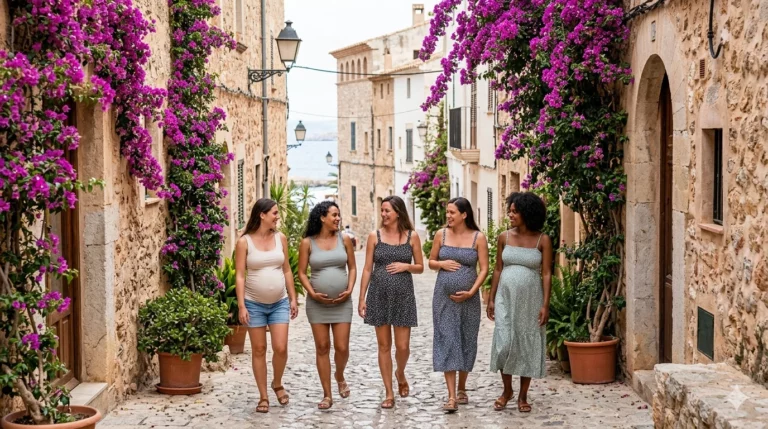
The term has been circulating for a few years now, in conversations between expectant mothers and on the glossy pages of women’s magazines: the prenatal retreat. A stay of a few days to prepare for birth in a different way, in a setting chosen with intention.
But behind this still-emerging concept, the offering is far from consistent.
Here is what a qualified midwife wants you to know before booking your solo babymoon.

What is a prenatal retreat?
A prenatal retreat is a three-to-seven-day stay designed for pregnant women — generally from the second trimester onwards — who wish to prepare for the birth ahead in a dedicated setting, within a small group, around a structured programme combining treatments, rituals, workshops and rest.
The concept draws from yoga retreats, wellness stays and the age-old tradition of withdrawal before birth found in most non-Western cultures. Its contemporary, carefully curated — sometimes luxurious — form has developed across Europe over the past five years.
The 6 criteria for choosing the right retreat
1. The presence of a qualified midwife
For us, this is the non-negotiable criterion. A midwife is the only medical professional qualified to monitor a physiological pregnancy on a continuous basis. Her presence ensures that all treatments offered are appropriate for your stage of pregnancy, that contraindications are identified, and that in the event of a minor incident — dizziness, a contraction, a moment of faintness — the response will be immediate and professional.
2. Group size
Beyond ten participants, individual attention begins to dilute. The ideal ratio sits between six and eight women — the threshold beyond which a sharing circle becomes an audience and a treatment becomes a transaction.
3. The stage of pregnancy covered
The medically safest window for travelling during pregnancy is the second trimester, between weeks 14 and 32 of amenorrhea. Beyond this, the risk of complications increases and airlines tighten their conditions. Ensure the retreat is designed for this window and that a medical fitness certificate is required at registration.
4. The setting: private villa or hotel
A private villa guarantees complete privacy: no tourists in the corridors, no afternoon pool noise, no shared dining room with other guests. For a prenatal stay, this intimacy is not a luxury — it is a condition for the experience to truly work.
5. Full board and the quality of the chef
During pregnancy, food is an act of care. A retreat that does not offer full board prepared by a chef trained in prenatal nutrition sends you back to navigating menus — precisely what a retreat is meant to spare you from.
6. Included treatments
The essential treatments for a prenatal retreat are: a prenatal massage carried out by a trained therapist, lymphatic drainage (highly effective for the water retention common in the third trimester), gentle adapted yoga sessions, and ideally perinatal sophrology. Verify that these treatments are included in the price and not billed as extras.

Our advice
If you are weighing up several options, ask these two questions when you make an initial enquiry:
- Who will be accompanying me, and what are their qualifications?
- How many women will be in the group, exactly?
The answers to these two questions separate serious retreats from marketing products.
Soleia Retreats is Europe’s first prenatal retreat founded by a qualified midwife. The only solo babymoon guided by a certified perinatal health professional.